Finance Minister Nirmala Sitharaman presented her 9th Union Budget speech on 1st February, 2026. This year, Indian Railways received a major infrastructural push, with the highest-ever allocations to date. This allocation is part of the government’s continued focus on strengthening railway connectivity, increasing capacity, and promoting environmentally sustainable passenger transport.
The budget prioritised rail safety with a significant boost to Kavach Version 4.0, the automatic train protection system. This rollout is a step to improve rail safety,
Read on as we learn more about the railway budget, its features, and the new trains announced in the Budget 2026.
Union Budget 2026: Railway Allocation
A total capex of ₹2,93,030 crore has been allocated to Indian Railways in the Union Budget 2026. High-speed connectivity, Vande Bharat expansion, freight movement, and safety are the key priorities.
Soon, new trains by Indian Railways will be inaugurated to make commuting easier and more comfortable.
High Speed Rail Corridors: Routes & Other Details
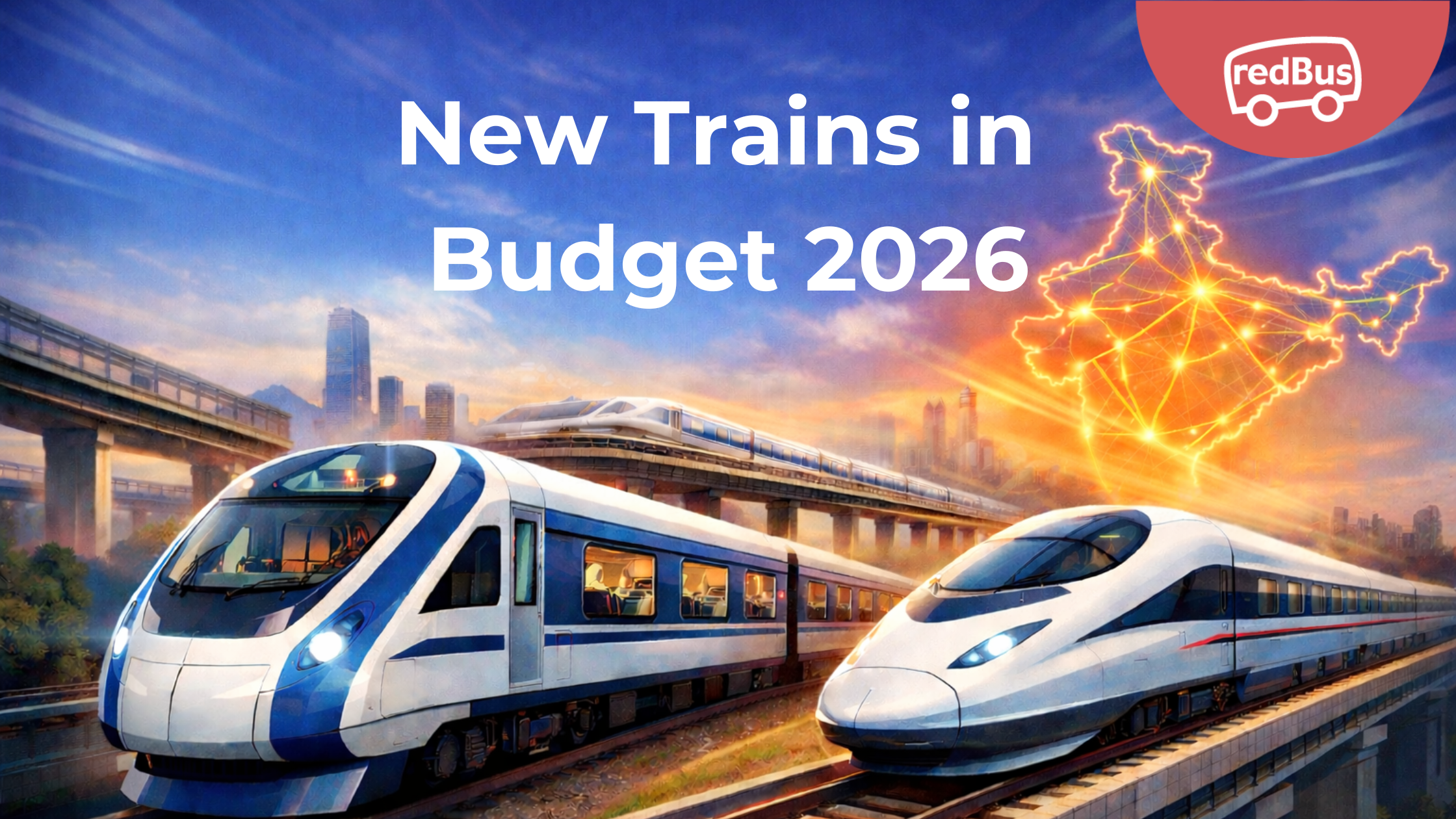
At present, India has no high-speed corridors. As a part of the Union Budget 2026, the government announced 7 new high-speed rail corridors.
The seven high-speed rail corridors are:
- Mumbai – Pune
- Pune – Hyderabad
- Hyderabad – Bangalore
- Hyderabad – Chennai
- Chennai – Bangalore
- Delhi – Varanasi
- Varanasi – Siliguri
The first one, connecting Ahmedabad and Mumbai, is under construction. The first phase of this corridor is expected to be opened by 2027.
Major routes that were highlighted for the upcoming railway expansion are:
- In the South, the Chennai-Bengaluru-Hyderabad triangle will serve for Kerala, Tamil Nadu, Andhra Pradesh, Telangana, and Karnataka
- Pune, Mumbai, and Hyderabad are expected to emerge as economic corridors of India
- In the north, the Delhi-Varanasi-Siliguri corridor will serve Bihar, Uttar Pradesh, West Bengal, and Delhi.
The plan is to build a 4,000-kilometre high-speed railway corridor to improve connectivity and reduce intercity and interstate travel times. It is expected that the rail corridors will attract investments worth ₹16 lakh crore.
Vande Bharat Trains Expansion and More
Vande Bharat Trains are semi-high-speed trains that operate on several routes across India. In the Union Budget 2026, the Finance Minister also announced plans to expand Vande Bharat services.
The government has recently launched a 16-coach Vande Bharat sleeper train from Howrah to Kamakhya. The national transporter has announced the introduction of 24-car Vande Bharat sleeper rakes, and 50 such rakes are currently under production at Chennai-based Integral Coach Factory (ICF).
Railway Minister Ashwini Vaishnaw also stated that 17,000 coaches of Amrit Bharat and Namo Bharat trains are currently under construction. These introductions will connect major cities, boosting economic and regional development.
Frequently Asked Questions
Does India currently have high-speed bullet trains?
No. Currently, there are no functional high-speed bullet corridors in India. However, the first one is under construction between Ahmedabad and Mumbai. It is expected to become functional by 2027.
What is the Himalayan Rail expansion plan?
The government plans to improve the Rishikesh–Karnaprayag Line and the Uri Extensions. It is done to make remote areas accessible. Further, it is also expected to enhance all-weather connectivity, tourism, and pilgrimage.
What is the Northeast underground rail corridor?
To strengthen connectivity between the Northeast and the rest of India, the government has planned an underground rail corridor. It is planned to be 40 km long with four-line expansion, so there is no interruption in the movement of passengers or freight.
What is Kavach Version 4.0?
On 30th January 2026, Indian Railways introduced Kavach Version 4.0, an automatic train protection system. The system is now active on three key sections of the network: the Vadodara-Virar stretch, the Tuglakabad Junction Cabin-Palwal section, and the Manpur-Sarmatanr section. The system ensures safer and more reliable train operations, even on the busiest routes.
What is the expected travel time of the upcoming high-speed rail corridors?The high-speed rail corridor is expected to substantially reduce intercity and interstate travel times. The travel time for Varanasi–Siliguri is expected to be around 2 Hours 55 Minutes; Delhi to Varanasi, around 3 Hours 50 Minutes; Mumbai to Pune, around 48 minutes; and Chennai to Bengaluru, around 1 Hour 13 Minutes.
Which states have received the high allocations in the Railway Budget in 2026-2027?
Maharashtra has been allocated the highest railway budget in 2026-27 among all states in India, at ₹23,926 crore. After this, Uttar Pradesh has received ₹20,012 crore, West Bengal ₹14,205 crore, Gujarat ₹17,366 crore, Madhya Pradesh ₹15,188 crore, Assam & Northeast Region ₹11,486 crore, Bihar ₹10,379 crore, and Odisha ₹10,928 crore.